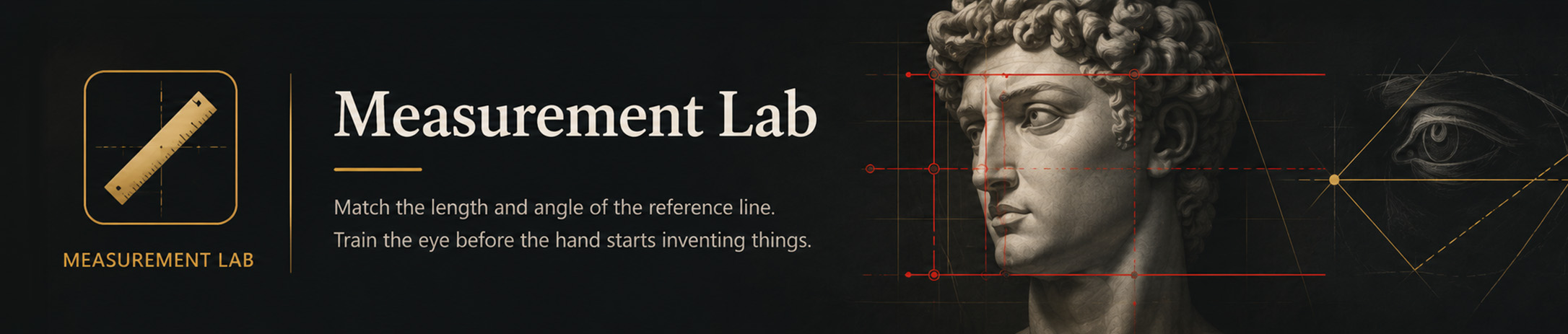
Measurement Lab
Match the length and angle of the reference line. Train the eye before the hand starts inventing things.
Draw the matching line on the blank panel.
First attempt — Adjusted —
Measurement Guide – Proportion, Angles and Placement
Measurement Guide – Proportion, Angles and Placement
Measurement in drawing is really about comparison. Instead of asking, “What is the exact size of this?”, ask, “How does this relate to everything around it?”
These comparisons help you judge proportion, angle and placement more accurately while still keeping the drawing responsive and visual.
Relative Proportion
Proportion describes the size of one part in relation to another.
An arm may be slightly longer than the width of the torso. One eye may sit approximately one eye-width from the other. A shape may be twice as tall as it is wide.
Thinking in relationships is often more useful than thinking in fixed measurements because it allows you to compare directly with the subject in front of you.
Angles and Direction
Lines rarely exist in isolation. Their direction can be compared with horizontal, vertical or another nearby edge.
Learning to recognise whether an angle is steep, shallow, rising or falling helps you place forms more accurately and understand how they move through the drawing.
Small errors in angle can create surprisingly large changes further along a shape, so this is one of the most useful skills to train.
Placement
Placement is about where something sits in relation to the rest of the drawing.
A line can be the correct length and angle but still feel wrong if it begins or ends in the wrong place.
Comparing distances from neighbouring shapes, centre lines, verticals and horizontals helps you check whether the structure is sitting where it should.
Comparative Measurement
Comparative measurement uses one part of the subject as a reference for another.
Rather than measuring everything separately, you establish a useful unit and compare other lengths against it. This creates a network of relationships across the drawing.
The exact unit matters less than the consistency of the comparison.
Plumb Lines and Alignments
Vertical and horizontal alignments can reveal relationships that are difficult to judge by eye alone.
You might notice that the edge of a nose aligns with the corner of a mouth, that a hand sits directly beneath a shoulder, or that two distant points share the same horizontal level.
These alignments are simple but powerful ways of checking placement.
Visual Memory
Drawing also depends on your ability to observe something, hold that information briefly in your mind and reproduce it.
Training visual memory helps you retain angles, proportions and spatial relationships instead of constantly looking back and forth without processing what you see.
The aim is not photographic memory. It is more deliberate observation.
Accuracy and Adjustment
Accuracy is not about getting everything right on the first attempt.
Good drawing often involves making an estimate, checking it, recognising the difference and adjusting.
That process is important. Each correction teaches your eye what the relationship actually looks like.
From Measurement to Intuition
Measurement is most useful when it supports observation rather than replacing it.
At first you may consciously compare many lengths and angles. With practice, those comparisons begin to happen more naturally and your judgement becomes faster and more intuitive.
The aim is not to measure more. It is to learn to see more accurately.
Lab note: Measurement is a checking tool, not a rulebook. Observe first, compare relationships, make a judgement and adjust when needed. Over time, the process becomes part of how you naturally see and draw.
Teaching point Accuracy improves through comparison. Judge the relationship between the endpoints, angle and surrounding landmarks rather than guessing an isolated length.
Explore the Measurement Lab Preview
Try a selection of the Lab’s tools and exercises before unlocking complete access.
Selected measurement exercises and core controls.
Some advanced features, exercises and references remain locked.
Preview access only.
Independent preview; Academy lessons, exercises and forums are not included.
All Labs are also included with an active KN Creative Academy membership.
ONELAB29All Labs offerALLLABS75